
Field Notes
The breaker box horror movie
A history of American residential wiring, told one electrocution at a time.
If you’ve never opened a breaker panel in a 1960s home, you should — once, with a pro, while wearing the right gear. It will recalibrate your view of how much luck has been involved in your life so far.
This is not a story about modern electrical work. Modern panels are pretty good. This is a story about the 40-year arc of bad ideas that’s still buried in the walls of millions of American homes.
The aluminum wire era (~1965 — ~1975)
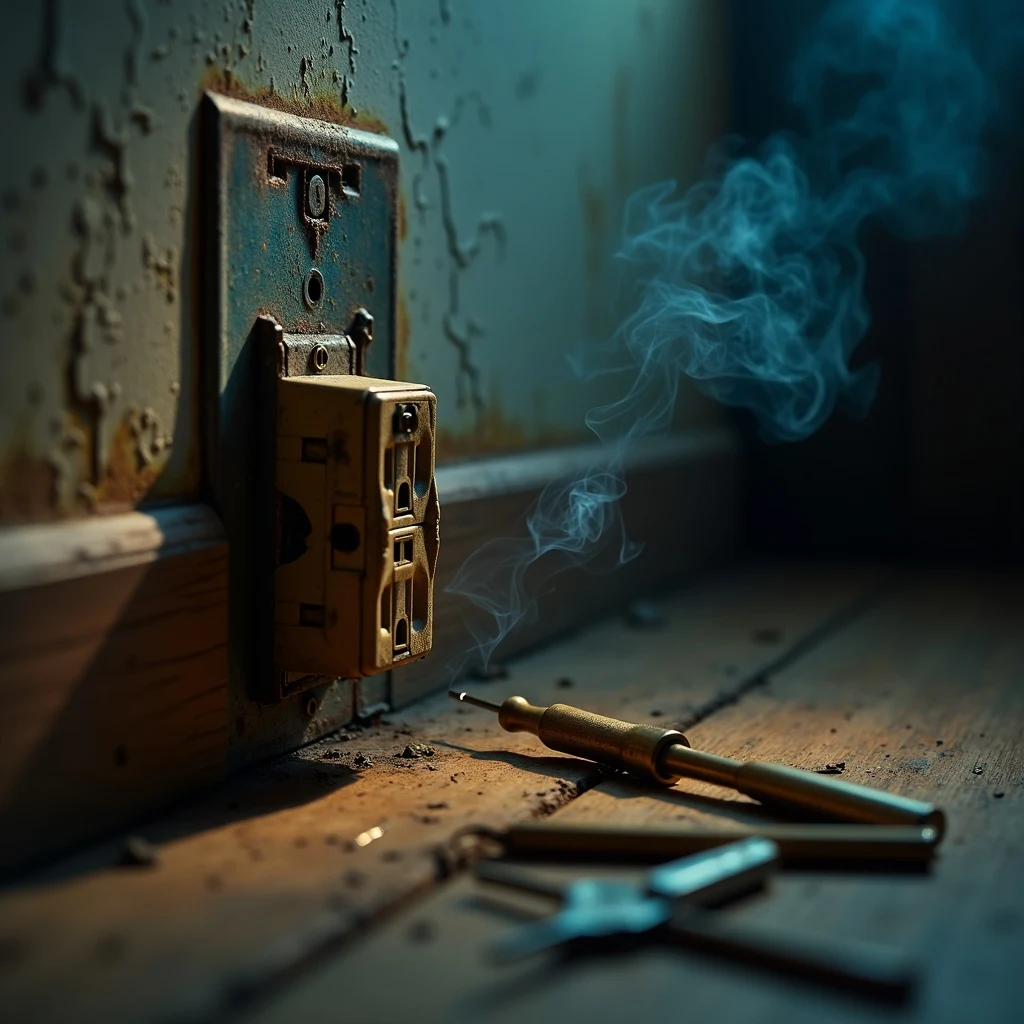
Copper got expensive. Builders switched to aluminum branch wiring in residential construction. It was cheaper, lighter, and just as conductive. What it wasn’t was compatible with the standard receptacles and switches that were rated for copper.
Aluminum:
- Expands and contracts more than copper with heating cycles, which loosens connections
- Forms an oxide layer on the surface that’s a poor electrical conductor
- Creep flows under steady pressure — over years, it deforms under the screw and the connection loosens further
A loose aluminum connection at a receptacle is a fire-starter. Each time you plug something in, you draw current through a high-resistance joint. The joint heats up. It ignites the wood it’s mounted to.
Houses built between ‘65 and ‘75 with all-aluminum branch wiring have a documented fire rate that’s 55x higher than houses with copper. Most of those houses are still standing. The wiring is still in them.
Federal Pacific Stab-Lok (1957 — ~1980)
This is the breaker that doesn’t trip. Federal Pacific made millions of panels and breakers under the Stab-Lok brand. The breakers had a defect: the calibration was wrong, and the trip mechanism didn’t reliably engage when the circuit overloaded.
What this means in practice: an FPE panel with a Stab-Lok breaker rated for 20 amps will sometimes carry 30, 40, even 60 amps without tripping. The wire downstream isn’t rated for that. The wire heats up. The wire’s insulation degrades. The wood the wire passes through ignites.
Federal Pacific went out of business in 1980. The panels are still in walls. I find them in two or three houses a month.
Zinsco panels (1950s — ~1980)
Same problem, different brand. Zinsco panels have an aluminum bus bar that corrodes over time, especially in humid climates. The corrosion creates resistance at the breaker-to-bus connection. Now even when the breaker trips correctly, the connection itself is hot and arcing.
A Zinsco panel doesn’t fail safely. It fails by burning the panel itself. The panel becomes the source of the fire.
Knob-and-tube (~1880 — ~1940)
This is the oldest of the bunch and counterintuitively the safest of the four — when it’s intact and uninsulated. Knob-and-tube is two-wire, no ground, but it’s spaced apart from the framing on ceramic insulators and runs through ceramic tubes when it crosses framing. Air-cooled.
The problem: when later owners blow insulation into the attic, the knob-and-tube gets buried. Now it’s running through cellulose insulation that holds heat in. The wire heats up. The cloth-and-rubber insulation degrades. Eventually the rubber fails and you have bare wires touching cellulose.
Most insurance companies refuse to cover homes with knob-and-tube wiring still in the attic because of this exact failure mode.
What I look for
When I’m in a panel:
- Brand — FPE, Zinsco, Pushmatic = immediate concern, document everything
- Aluminum branch wiring at receptacles — trace from panel out, look for “AL” stamping
- Heat damage — discoloration on the back of the breaker, scorch marks on the bus bar
- Double-tapping — two wires under one breaker, generally a code violation
- Backstabbed connections at receptacles — push-in instead of screw-down, fail over time
- Open junction boxes — anywhere a connection isn’t inside a covered metal or plastic box
The good news: every one of these has a known fix. The fix is rarely cheap. The fix is always cheaper than a fire.
If you live in a house built before 1980 and you’ve never had the panel inspected, schedule it. Find a certified inspector via InterNACHI. Or watch the episode for the visual tour of all four panels in the wild.