

Science
Why mold actually grows where it does
The chemistry of cellulose, the physics of dew points, and why your bathroom is a fungus playground.
Most homeowners think mold appears because their house is “dirty.” It isn’t. Mold grows because of three inputs that are usually invisible to anyone who doesn’t crawl through attics for a living: cellulose, dew point, and dwell time. Get all three right, and mold grows. Get one wrong, and it can’t.
The cellulose problem
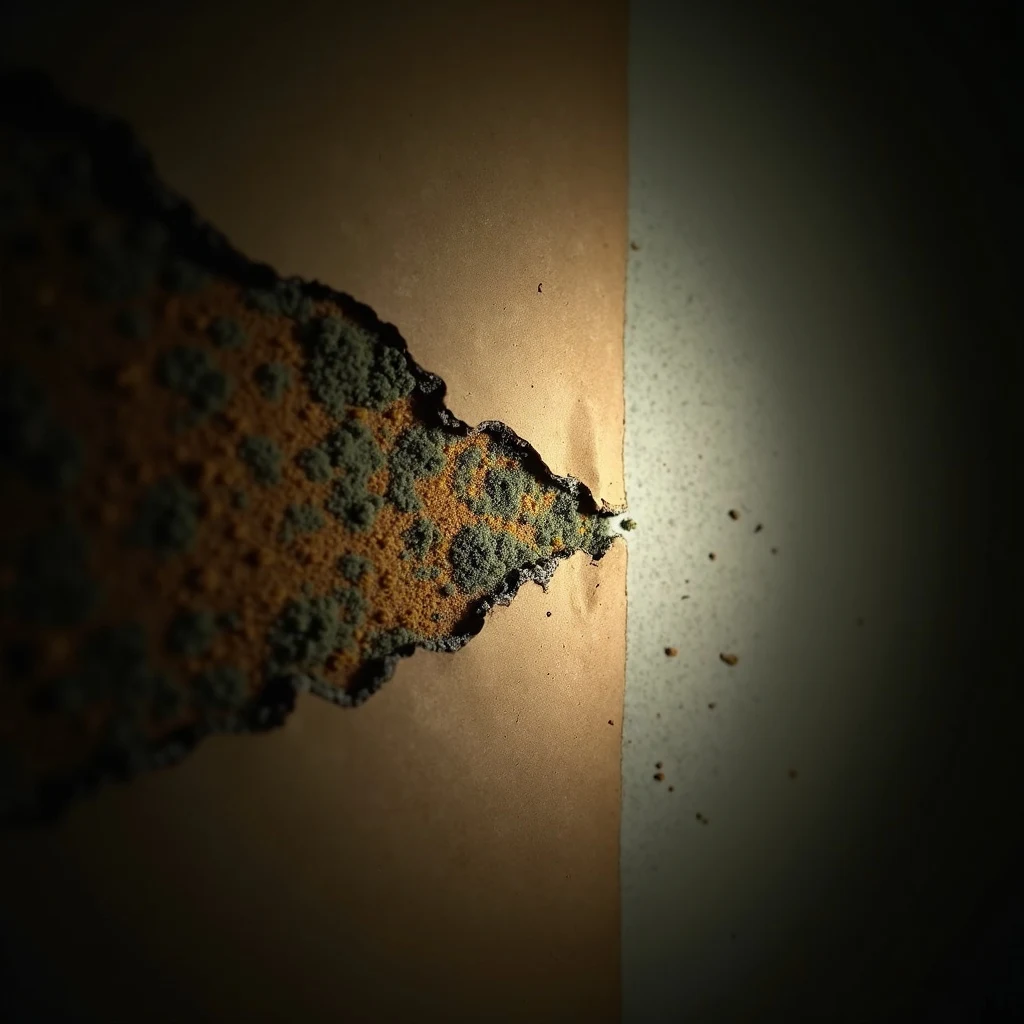
Mold doesn’t eat drywall paint. It eats the paper backing on the drywall. That paper is essentially compressed wood pulp — a buffet of cellulose. Same with the kraft paper on fiberglass insulation, the cardboard sheathing on the back of your medicine cabinet, the wood studs behind the wall, and the dust that builds up on horizontal surfaces.
Anywhere cellulose meets enough water for long enough, mold has a substrate.
The dew point trap
Dew point is the temperature at which the water vapor in the air condenses into liquid water. In a heated house in winter, you’ve got warm humid indoor air (say 68°F at 45% relative humidity) meeting cold surfaces. The dew point of that air is about 47°F. Anywhere a surface drops below 47°F — the inside of a poorly insulated wall, a window frame, a bathroom mirror — water condenses on it.
That water doesn’t evaporate immediately. It sits.

The dwell time multiplier
Mold spores are everywhere. They’re in your house right now — that’s not a problem. The problem is when those spores land on a surface that’s been wet for more than 24-48 hours. Below that threshold, the spores die. Above it, they germinate.
Bathrooms are the obvious case: hot shower → high humidity → dew on cold tile and grout → fan that doesn’t run long enough → spores germinate before the surface dries.
But the more interesting case is what happens behind your walls.
Why kraft-paper insulation backs that aren’t tight to drywall are a slow-motion mold factory
This is the one I see most often. When the kraft paper backing on fiberglass batts isn’t pulled tight against the back of the drywall, you’ve created an air gap. Inside that gap:
- Warm humid indoor air leaks in through electrical boxes and gaps around plumbing
- The drywall (60s°F room temperature) sits at near-room temperature on its outer face but cooler on the wall-cavity face because of the air gap
- The kraft paper sits at attic temperature, which in a Louisiana summer is 110°F+ during the day, 75°F at night
- Air movement happens — warm humid air rises into the cavity, hits the cooler drywall back, condenses
- Now you have liquid water on cellulose for hours every night
- After a season of this, the kraft paper is hosting active mold growth
The fix is mechanical: kraft paper has to be tight to the drywall, no air gap, no convection cell. This is one of those building-science details that’s easy to get wrong on a Saturday DIY job and impossible to fix later without opening the wall.
What this means for inspection
When I’m pulling thermal imaging on a wall and seeing a cool zone in winter that doesn’t match the studs, I’m not just looking for missing insulation. I’m looking for a place that’s about to start growing mold in the next two summers.
If you’re buying a house: ask whether the insulation is faced kraft, faced foil, or unfaced. Ask whether the vapor barrier is on the right side. Ask if the bathroom fan vents to outside or just into the attic. The answers will tell you what’s coming.

This is the kind of thing the show goes deeper on. Watch the episode →